Battery Backup, Water-Powered, or Generator: Which Sump Pump Backup Actually Works?
Figures last verified
The storm that floods your basement is frequently the same storm that takes out your power. That correlation is the entire problem, and it is why a sump pump with no backup is a system designed to fail at precisely the moment it is needed.
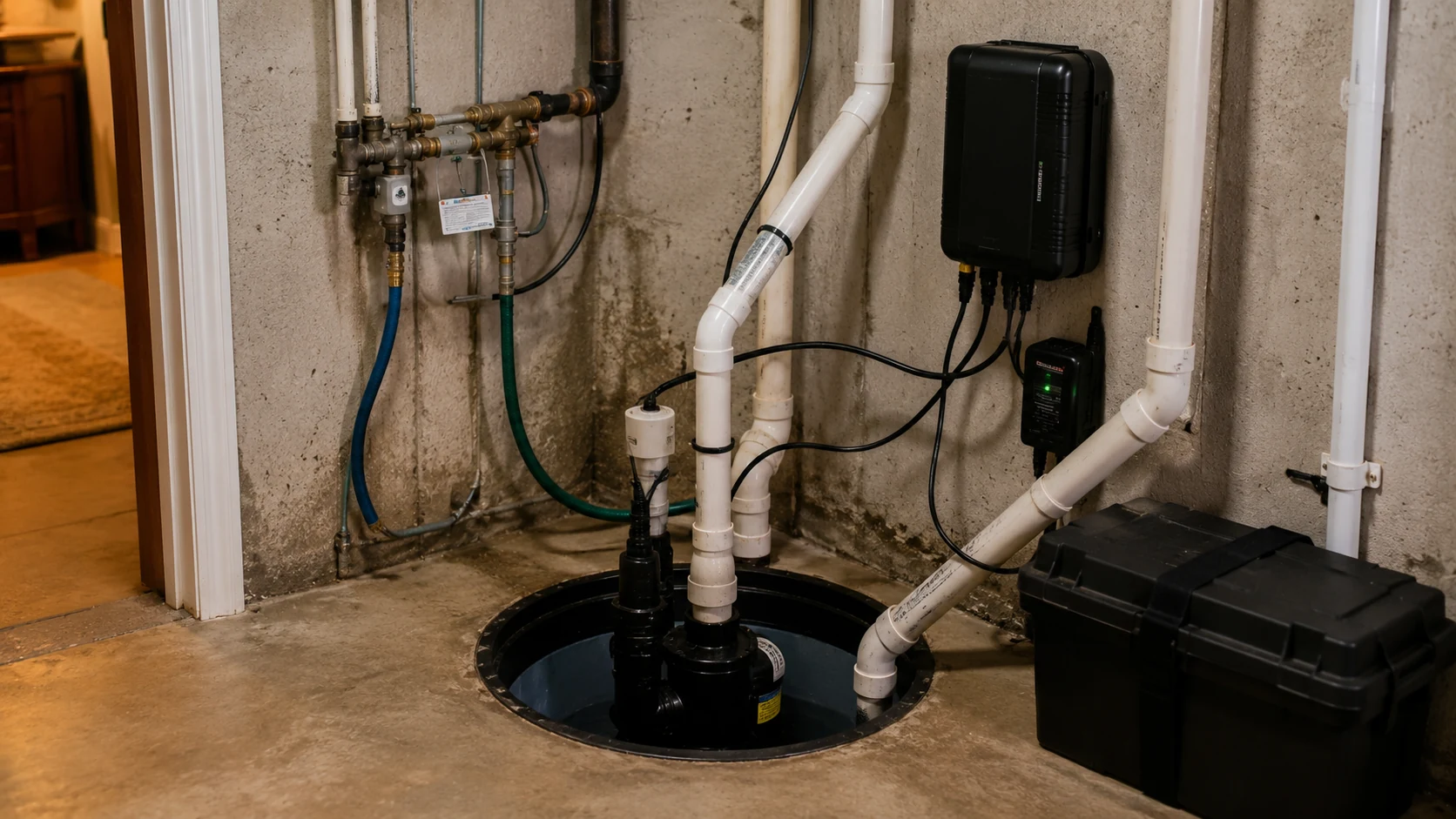
FEMA's guidance for homeowners in flood-prone areas states the obvious version plainly: sump pumps do not operate when electrical service fails. What that guidance does not do is compare the three ways of solving it, because the three options protect against genuinely different failures and most sources selling one will not tell you what the others do better.
The three failures you are protecting against
Before comparing products, be clear about what can go wrong, because the answer is different for each.
Grid failure. The power goes out and the primary pump stops. This is the common case and the one everyone thinks about.
Primary pump failure. The pump itself dies, or the float switch sticks, or the impeller jams on debris. Power is fine. The pump is not. This happens more often than people expect and a generator does nothing about it.
Capacity overrun. Water arrives faster than the pump moves it. A backup that pumps at half the primary's rate will not save you here.
A generator addresses the first failure only. A separate backup pump addresses the first two. Nothing cheap addresses the third except a properly sized primary.
The comparison
| Grid outage | Primary pump failure | Automatic response | Extended runtime | Works on well water | |
|---|---|---|---|---|---|
| Generator powering primary | Yes | No | No, needs you present | Yes, while fuel lasts | Yes |
| Battery backup pump | Yes | Yes | Yes | Limited by battery and cycling | Yes |
| Water-powered backup pump | Yes | Yes | Yes | Indefinite while pressure holds | No |
| Portable power station | Yes | No | Depends on setup | Limited by stored energy | Yes |
The column that eliminates options fastest is the last one.
Water-powered backup, and why it may not apply to you
A water-powered backup pump uses municipal water pressure to drive an ejector that lifts sump water out. It has no motor, no battery, no electrical connection and nothing to maintain. As long as the water main holds pressure, it runs indefinitely, which is a genuinely remarkable property in a backup system.
It also consumes municipal water to do it, typically somewhere around one to two gallons of supply water per gallon pumped out, which appears on your bill. During a long event that is a real cost, though a smaller one than a flooded basement.
The disqualifier is the water source. If your household is on a private well, the well pump is electric, so a power outage takes your water pressure away at the same moment it takes your sump pump. A water-powered backup on a well property does nothing during the exact scenario it exists for.
That single fact splits the audience cleanly. Municipal water households should look seriously at water-powered backup. Well households should not consider it at all, and should read running a well pump during a power outage instead, because they have a related and larger problem.
Check local plumbing code as well. Some jurisdictions restrict these installations or require specific backflow prevention, since the device connects potable supply to a sump.
Battery backup pumps
A dedicated battery backup is a second pump, usually 12 volt DC, mounted alongside or above the primary, with its own float switch and a charger keeping a deep cycle battery topped up.
It handles both the outage case and the primary pump failure case, and it switches over automatically without anyone being home. That automatic operation is worth a great deal, because basements flood at three in the morning while people are asleep or away.
The limitation is runtime, and this is where marketing figures mislead badly. Manufacturers quote maximum runtime, which typically describes continuous pumping or a light duty cycle. Real runtime depends entirely on how often the pump cycles, and during the heavy rain that caused the outage it cycles constantly.
The honest way to estimate it is by cycles rather than by hours.
A typical 12V backup pump draws somewhere between 20 and 40 amps while running. A 100 amp hour deep cycle battery, discharged to a sensible fifty percent for a flooded lead acid unit, gives you 50 usable amp hours. At 30 amps draw that is roughly one hundred minutes of actual pumping.
Now count cycles. If your primary pump runs for thirty seconds every ten minutes in ordinary rain, that is three minutes of pumping per hour, and one hundred minutes of capacity covers thirty three hours. If heavy rain drives it to thirty seconds every minute, that is thirty minutes of pumping per hour, and the same battery covers three and a half hours.
An order of magnitude difference, driven entirely by rainfall intensity. Watch your own pump during a storm with a stopwatch, note the interval, and you will have a far better estimate than any specification sheet provides.
Two practical points. Backup pumps generally move less water than the primary, often half the gallons per minute, so they are designed to keep up rather than to match. And the battery needs testing, because a maintenance-free battery sitting on a trickle charger for four years is frequently dead when called upon. Load test it annually.
Generator powering the primary
A generator restores power to the existing pump, which means full pumping capacity rather than a reduced backup rate. That is its main advantage and it is significant during a capacity-overrun event.
Its main disadvantage is that somebody has to start it. A portable generator does not respond to a float switch at three in the morning, and if the household is away it does nothing at all.
Sizing is straightforward and follows the same logic as any motor load. A third horsepower sump pump runs at roughly 800 watts and surges to somewhere between 1,300 and 2,900. A half horsepower unit runs near 1,050 and surges to around 2,150 or higher. Those surge figures are what determine generator size, and the full method is in the generator sizing guide.
Connecting it is the other consideration. A sump pump is often on a dedicated circuit, and powering it properly means an interlock or transfer switch rather than a cord run through a window. That comparison is covered in how to connect a portable generator.
Portable power station
A battery station powering the existing pump sits between the other options. It responds automatically if the pump is simply plugged into it, it needs no fuel, and it makes no noise.
Runtime is the constraint and the arithmetic is the same as for a dedicated backup. A 2,000 watt hour station against a pump drawing 800 watts while running gives you roughly two and a half hours of actual pumping, which against a light cycling pattern is a day or more and against heavy rain is a few hours.
Surge is the other constraint. Check the station's surge rating against the pump's starting draw, not its continuous rating against the running draw. The same principle applies as with refrigerators and freezers, and it catches people out the same way.
What I would actually do
The layered answer, in the order the money is best spent.
A water alarm first. Twenty dollars, battery powered, sits on the basement floor and screams if water reaches it. It does not pump anything, and it is the cheapest way to convert a catastrophe into an inconvenience, because most basement flooding damage comes from water that sat unnoticed for hours.
Then a dedicated backup pump matched to your water source. Water-powered if you are on municipal supply and code permits it. Battery backup if you are on a well, or if municipal pressure in your area is unreliable.
Then a battery sized against your actual cycling rate, if you went the battery route. Measure the interval during a real storm rather than trusting a runtime specification.
Then a generator if you have other reasons to own one, which most people with a sump pump problem do, since the same storms take out heating and refrigeration. Treat the sump capability as a bonus rather than the justification.
And check the discharge line. A backup pump that runs perfectly into a frozen or blocked discharge pipe accomplishes nothing. Separate discharge for the backup where possible, and check the outlet before storm season.
The thing worth measuring this week
Stand in the basement during the next real rain with a phone timer. Note how long the pump runs and how long it rests. Two numbers, five minutes of your time.
Those numbers convert every runtime claim in this category from marketing into arithmetic, and they will tell you whether a battery that a manufacturer rates at eight hours will give you eight hours or ninety minutes at your house.
Sources
- FEMA, Urban Flooding: Guidance for Homeowners and Renters
- Manufacturer specifications for 12V DC backup sump pumps and water-powered ejector pumps
- Local plumbing codes vary on water-powered backup installation and backflow prevention
Related: Running a well pump during a power outage covers the related problem for well households. How long do power outages actually last where you live covers how much runtime to plan for.
This page is general information. Sump pump and backup installation is regulated plumbing and electrical work in most jurisdictions.
Last verified: July 2026