How Long Will a Power Station Run a Refrigerator or Freezer?
Figures last verified
A 1,000 Wh power station with 85% usable AC energy can run a refrigerator rated at 500 kWh/year for about 15 hours. That is a calculation, not a universal runtime: use your appliance's EnergyGuide figure and the station's documented or measured usable energy in the calculator below.
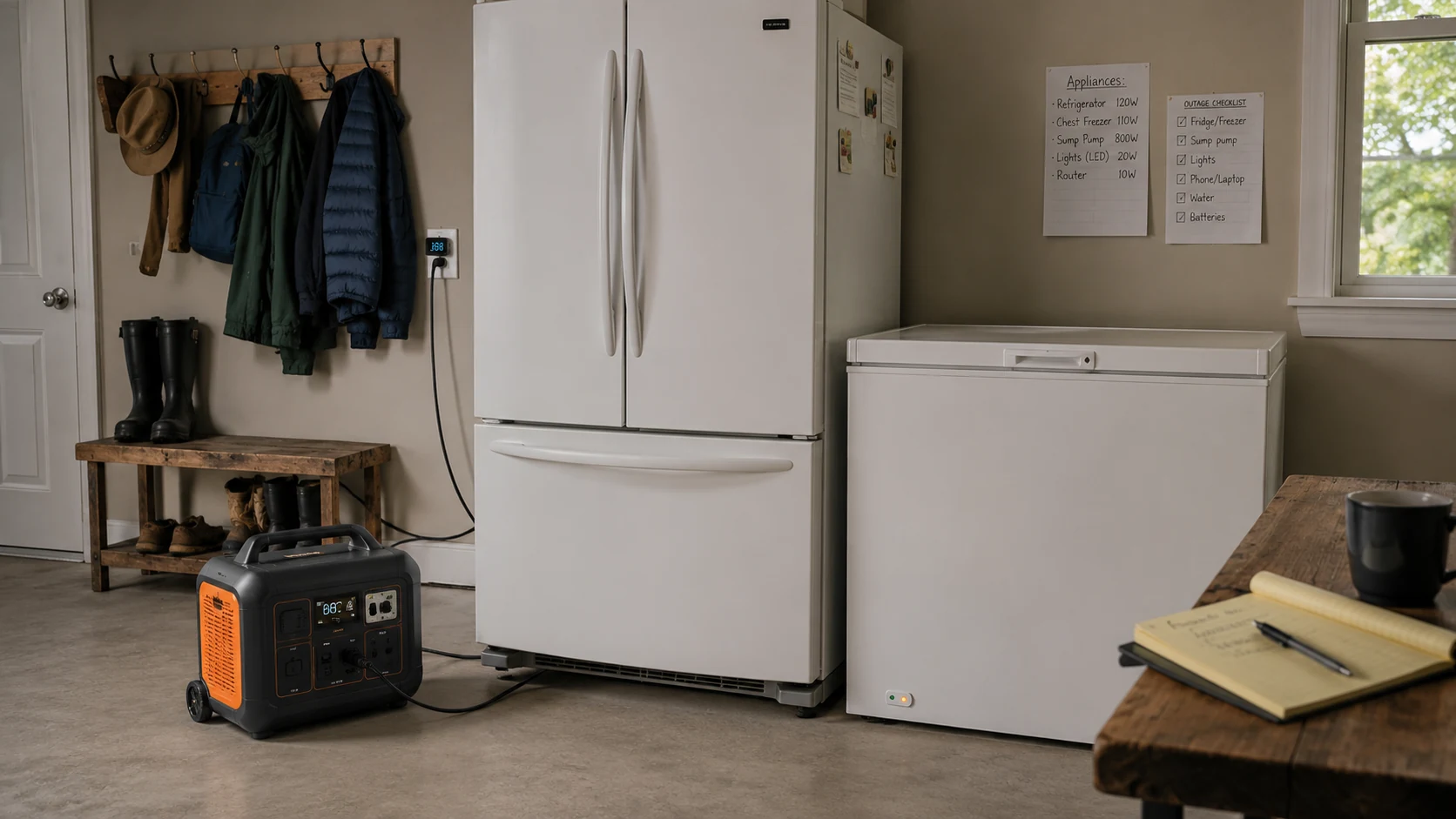
Refrigerator and freezer runtime calculator
Use the annual kWh from the appliance's EnergyGuide label. Every result is a calculation from your inputs, not a claim that any station was tested.
- Estimated appliance energy
- 1,370 Wh/day
- Usable station energy
- 850 Wh
- Estimated runtime
- 14.9 hours
- Nameplate capacity for 24 hours
- 1,612 Wh
Formula: annual kWh x 1,000 / 365 = daily Wh. Runtime = nameplate Wh x usable percentage / total daily Wh x 24. Temperature, door openings, battery state, and inverter behavior can change real results; measure when the consequence matters.
Download the runtime worksheet (CSV)
Questions people ask
- Does a 1,000-watt power station store 1,000 watt-hours?
- No. Watts describe how quickly it can supply power; watt-hours describe stored energy. Inverter wattage and battery watt-hours are separate specifications.
- Why use annual kWh instead of refrigerator watts?
- A refrigerator cycles on and off. Annual kWh from an EnergyGuide label captures that cycling under the federal test procedure, while a running-watt figure does not state daily energy use.
- Does the runtime estimate prove that the compressor can start?
- No. Runtime is an energy calculation. Startup is a separate power check: the station surge rating must meet the appliance startup demand.
The two checks that decide whether it works
Runtime requires an energy check. Compressor startup requires a separate power check.
- Energy: Convert the appliance's annual kilowatt-hours to daily watt-hours, then divide usable battery energy by daily appliance energy.
- Power: Confirm the station's surge rating meets the appliance's startup demand and its continuous rating covers the running load plus anything else connected.
A battery can contain enough energy for many hours and still fail to start the compressor. Conversely, a high-watt inverter may start the appliance but be attached to a small battery that empties quickly. The two numbers answer different questions, and confusing them is the most common sizing mistake: watts versus watt-hours works through the distinction.
Use the appliance's annual kWh, not a generic wattage chart
The yellow EnergyGuide label reports estimated annual energy use. The FTC requires EnergyGuide disclosures for refrigerators and freezers, and those figures are based on Department of Energy test procedures. The federal procedure measures annual energy use in kWh/year and is intended to simulate typical room conditions. That makes annual kWh a defensible planning input, but it is still a standardized result rather than a measurement of your kitchen or garage.
If the label is gone, try the manufacturer's model page, the ENERGY STAR Product Finder, or the Department of Energy's refrigerator and freezer rating search tool for 2000-2010 models. For the best answer, measure the appliance over several representative days with an appropriate plug-in energy meter.
The conversion is:
daily Wh = annual kWh x 1,000 / 365
For example, 500 kWh/year becomes 1,370 Wh/day. No duty-cycle assumption is needed because cycling is already reflected in the annual energy figure.
Original runtime comparison
The following table applies one consistent assumption: 85% of station nameplate capacity is available to the AC appliance. That percentage is an editable planning assumption, not a confirmed specification for every product.
| Annual appliance energy | Calculated daily energy | 1,000 Wh station at 85% | 2,000 Wh station at 85% |
|---|---|---|---|
| 215 kWh/year | 589 Wh/day | 34.6 hours | 69.2 hours |
| 395 kWh/year | 1,082 Wh/day | 18.9 hours | 37.7 hours |
| 500 kWh/year | 1,370 Wh/day | 14.9 hours | 29.8 hours |
| 700 kWh/year | 1,918 Wh/day | 10.6 hours | 21.3 hours |
The 215 and 395 kWh/year inputs are EPA examples for an ENERGY STAR chest freezer and upright freezer, respectively. The 500 and 700 kWh/year rows are calculation scenarios, not category averages. The calculator above lets you replace every assumption with your own figures.
How to choose the usable-energy percentage
Nameplate watt-hours describe stored DC energy. An AC refrigerator is supplied through an inverter, and the station may also reserve energy before shutdown. The resulting usable AC energy varies with the station, load, temperature, state of charge, and product behavior.
Use one of these inputs, in descending order of confidence:
- a measured AC discharge result at a comparable load;
- a manufacturer specification that explicitly states usable AC energy;
- a conservative planning assumption that you keep editable and label as an assumption.
The calculator defaults to 85% only so it can demonstrate the arithmetic. It does not assert that every unit delivers 85%.
Check compressor startup separately
Do not estimate startup demand by multiplying a generic running-watt number. Look for a manufacturer startup or locked-rotor specification, or measure with equipment designed to capture inrush current. Then compare that figure with the station's surge rating and duration.
If either figure is unknown, startup compatibility is unknown. A successful runtime calculation does not resolve it.
Food-safety limits still apply
FoodSafety.gov says an unopened refrigerator keeps food safe for up to four hours without power. A full freezer holds temperature for about 48 hours and a half-full freezer for about 24 hours when the door remains closed. Keep appliance thermometers inside: the refrigerator should be at or below 40 F (4 C), and the freezer at or below 0 F (-18 C).
Those times are food-safety guidance, not battery-runtime estimates. Do not use calculated runtime or occasional compressor operation as proof that food remained safe. Follow the FoodSafety.gov outage chart when deciding what to keep or discard.
What about solar recharging?
Solar changes runtime only when energy actually reaches the battery. Panel nameplate watts multiplied by daylight hours will overstate production. Weather, orientation, shade, controller limits, temperature, and conversion losses all matter.
For multi-day planning, calculate appliance energy first, then model the charging system separately with the solar sizing calculator. If the property also depends on a well, read how to run a well pump during an outage before assuming the refrigerator is the largest load.
A repeatable sizing procedure
- Record annual kWh from the EnergyGuide label, model documentation, or a multi-day measurement.
- Convert annual kWh to daily Wh.
- Add other loads in Wh/day.
- Apply a documented or conservative usable-energy percentage to the station's nameplate Wh.
- Calculate runtime and the capacity required for the target outage.
- Check startup demand against surge rating as a separate pass/fail test.
- Validate the setup before an outage and monitor appliance temperature during one.
The generator sizing guide uses the same separation between running load, startup demand, and energy supply. The outage-duration analysis helps choose a realistic number of hours to cover.
Get practical Power field notes
Get practical Power updates and revised tools when the underlying data changes. Double opt-in; unsubscribe from any email.
Sources and evidence labels
- Confirmed rule and test basis: FTC, EnergyGuide Labeling FAQs, accessed August 12, 2026; 10 CFR Part 430, Subpart B, accessed August 12, 2026.
- Confirmed food-safety guidance: FoodSafety.gov, Food Safety During Power Outage, accessed August 12, 2026.
- Government product data: EPA ENERGY STAR certified product datasets and APIs, accessed August 12, 2026; EPA ENERGY STAR refrigerators, accessed August 12, 2026.
- Calculation/inference: all runtime and required-capacity figures on this page are outputs of the displayed formulas using stated inputs.
- Unknown until checked for a specific setup: real usable AC energy, compressor startup demand, surge duration, ambient-temperature effect, and solar production.
No first-hand product testing is claimed on this page.