How Do You Run a Well Pump During a Power Outage?
Figures last verified
A residential well pump needs surprisingly little energy over a day and a surprisingly large amount of power for about two seconds. That single distinction decides everything about what will run it, and it is the reason so many people buy a generator that cannot start their pump.
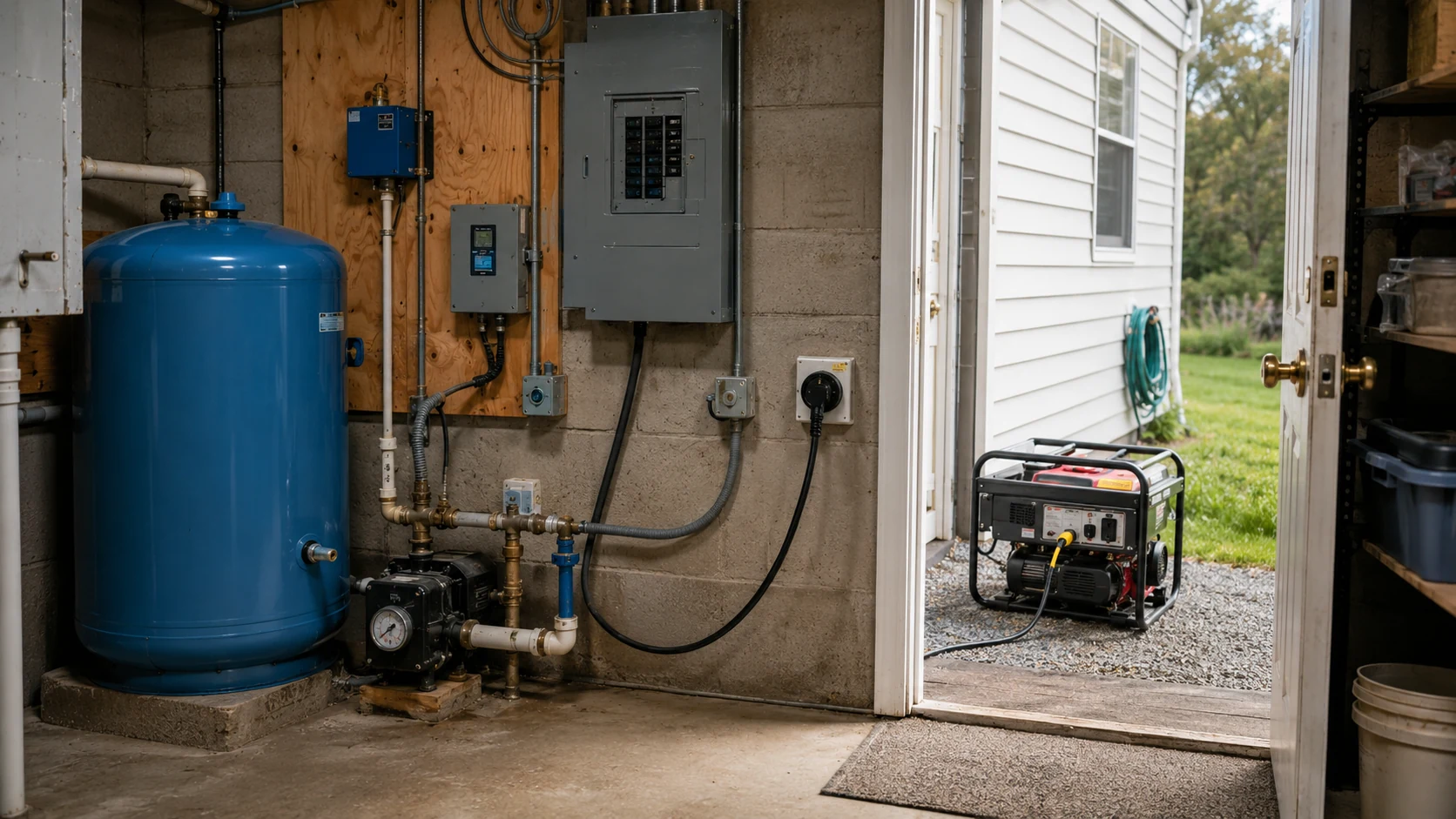
The number that matters is not horsepower and not running watts. It is locked rotor amps, printed on the pump's nameplate, and this page is about how to find it and what to do with it.
Why losing power means losing water
Municipal customers keep water pressure for a while during an outage because the utility maintains pressure at scale. Well households do not. The pump is in your house, on your circuit, and when the circuit dies the water stops immediately.
That means a well household loses drinking water, cooking water, toilet flushing and washing at the same moment it loses lights. It is a materially worse outage than the same event on municipal supply, and it is the reason well owners end up researching generators when their neighbours do not.
It also means the water storage planner matters more for you than for most households, because stored water is what covers the gap before the generator is running.
Running load is small. Starting load is not.
A well pump is an induction motor, and induction motors draw an enormous transient current for the first fraction of a second while the rotor comes up to speed. That inrush is typically three to six times the running current, and on a submersible pump it can be higher still.
Here is the shape of the problem for a typical residential installation.
| Pump | Running watts | Typical starting watts | Daily energy |
|---|---|---|---|
| 1/2 hp shallow well jet, 120V | 800 to 1,000 | 2,000 to 3,000 | 0.4 to 0.8 kWh |
| 1/2 hp submersible, 240V | 900 to 1,100 | 2,500 to 3,500 | 0.4 to 0.9 kWh |
| 3/4 hp submersible, 240V | 1,200 to 1,500 | 3,500 to 4,500 | 0.6 to 1.2 kWh |
| 1 hp submersible, 240V | 1,500 to 2,000 | 4,500 to 6,000 | 0.8 to 1.6 kWh |
| 1.5 hp submersible, 240V | 2,200 to 2,800 | 6,000 to 9,000 | 1.2 to 2.4 kWh |
Look at the last column against the second. A one horsepower pump serving a normal household consumes somewhere around a kilowatt hour a day, which is roughly what a modern refrigerator uses. But it demands four and a half to six kilowatts for a moment every time it starts.
That asymmetry is why battery capacity is rarely the constraint and inverter output usually is. A power station with plenty of stored energy will refuse to start a pump if its surge rating falls short, and it will do so without any warning beyond a click and an error light.
Read the nameplate before you buy anything
Every well pump carries a data plate. On a submersible installation it is on the control box or the pressure switch enclosure rather than on the pump itself, since the pump is at the bottom of the well. On a jet pump it is on the motor housing.
Six items on it matter, and most people only read one.
Voltage. This is the first fork in the road. A 120V pump can be run by a great many portable generators and by a fair number of power stations. A 240V pump requires a source with genuine 240V output, and a large proportion of small inverter generators and almost all portable power stations under three kilowatts do not have it. Check this before anything else, because it eliminates most of the market in one step.
Running amps. Multiply by the voltage to get running watts. A 4.5 amp draw at 240V is 1,080 watts.
Locked rotor amps, sometimes marked LRA or SF amps. This is the inrush figure and it is the number that determines whether a source can start the pump at all. Multiply by voltage the same way. An LRA of 20 at 240V is 4,800 watts of surge demand.
Horsepower. Useful as a sanity check against the amp figures, not as a sizing method on its own. Motor efficiency varies enough that horsepower alone will mislead you.
Service factor. A number slightly above 1.0, indicating how much the motor can be loaded beyond nameplate. Relevant when the pump is working hard against depth.
Well depth and pump setting, which you may have from the drilling report rather than the plate. Deeper settings mean more work per gallon, and a pump lifting from 300 feet behaves differently from the same unit at 80.
If the plate is unreadable or missing, a clamp meter on the supply conductor while the pump cycles will give you the running amps directly, and some will capture inrush. That is a twenty to forty dollar tool and it removes all the guesswork from this exercise.
Worked examples
A small 120V jet pump. Nameplate reads 9 amps running, LRA 27. That is 1,080 watts running and 3,240 watts starting. A 3,500 watt inverter generator handles it comfortably. A 2,000 watt unit does not, even though the running load is only half its rating.
A typical 240V half horsepower submersible. Nameplate reads 4.5 amps running, LRA 14. That is 1,080 watts running and 3,360 starting, but on 240V. A generator with 240V output rated 3,500 to 4,000 watts will start it. A 120V-only unit of any size will not run it at all.
A one horsepower submersible on a rural property. Nameplate reads 8 amps running, LRA 26. That is 1,920 watts running and 6,240 starting. This wants a 6,500 to 7,500 watt generator with 240V output, or the same pump fitted with a soft start device.
In each case, notice that the generator is sized by the starting figure and then spends almost all its life loaded at a fraction of that. That is normal and unavoidable for motor loads, and it is why the generator that runs your well will feel oversized for everything else. Working the same arithmetic across your whole house is what the generator sizing guide covers, and the pump is almost always the load that sets the size.
Soft starters change the arithmetic
A soft start device limits inrush by ramping voltage to the motor over a short interval rather than applying it instantly. On well pumps these are sold as pump start controllers or soft starters, and they typically cut starting current by half or better.
That can move a household from needing a 7,500 watt generator to needing a 4,000 watt one, which is a substantial difference in purchase price, weight, fuel consumption and noise. It also brings some pumps within reach of a large power station that would otherwise be unable to start them.
The device installs at the pump control box and is electrician work in most jurisdictions. It is worth pricing against the generator saving before assuming you need the bigger machine.
What about a battery instead?
For 120V pumps, a large power station with sufficient surge rating will run one. Look for a continuous inverter rating above your running watts and a surge rating above your locked rotor watts, and treat the surge number as the binding constraint.
For 240V pumps the picture is harder. Genuine 240V output on a portable power station usually requires either a large unit designed for it or two units linked in a split-phase configuration, and both are expensive relative to a generator that does the same job.
The advantage of a battery is that a well pump is an intermittent load. It runs a few minutes at a time, a handful of times a day, so a modest battery can cover a household's water needs without running an engine. A typical household using 200 gallons a day with a one horsepower pump needs somewhere around one to one and a half kilowatt hours, which a 2,000 watt hour battery covers with margin.
The disadvantage is the surge rating, which is exactly where batteries are weakest relative to their capacity.
Reducing how often the pump runs
The pressure tank is the forgotten variable in this whole subject.
A pressure tank stores water under air pressure so the pump does not need to start every time somebody opens a tap. A small or waterlogged tank means the pump cycles constantly, which is bad for the motor under normal conditions and expensive during an outage, because every start is another surge event.
Checking the tank's air charge takes ten minutes with a tyre gauge and is worth doing regardless. A larger tank, or a second one plumbed in parallel, meaningfully reduces cycling and therefore reduces both the energy and the wear during generator operation.
A pressure tank sized generously also means you can run the generator in blocks rather than continuously, filling the tank and then shutting down, which is the operating pattern that makes fuel last. That approach is worked through in more detail in the generator fuel planning guide.
Connecting it safely
A well pump is almost always a hardwired 240V circuit, which means you cannot run it from an extension cord. Getting generator power to it requires either an interlock kit on your main panel or a manual transfer switch, both fed through a properly installed inlet box.
Never attempt to backfeed a house through an outlet using a double-ended cord. It energises the utility conductors outside your home, it can kill line workers restoring service, and it bypasses every protective device in your panel. The Consumer Product Safety Commission has warned about this repeatedly and it remains the most common serious mistake in residential generator use.
The comparison between interlocks, transfer switches and cords is covered in full in how to connect a portable generator, and the short version is that a well household needs one of the first two because the load is hardwired and 240V.
The order to do this in
Find the nameplate and record voltage, running amps and locked rotor amps. Multiply each by the voltage. Those two watt figures are your specification.
Decide whether you need 240V. If you do, that eliminates most small generators and nearly all power stations, and it is better to know that before shopping.
Price a soft start device against the generator size it would save you. On larger pumps this frequently pays for itself.
Check the pressure tank air charge, because a healthy tank reduces cycling and therefore reduces everything else.
Then size the generator to the starting figure with modest headroom, arrange a legitimate connection through an interlock or transfer switch, and store enough water to cover the gap before the engine is running.
The water storage planner covers that last part, and it is the cheapest item on this list by a wide margin.
Sources
- Motor nameplate conventions, NEMA MG 1
- National Electrical Code Article 702, optional standby systems
- U.S. Consumer Product Safety Commission guidance on portable generator use
Related: What size generator do you actually need works the same arithmetic across the whole house. How long do power outages actually last where you live covers how much runtime you should plan for.
This page is general information. Well pump wiring and generator connection are regulated work in most jurisdictions and are worth doing with a licensed electrician.
Last verified: July 2026