Transfer Switch, Interlock, or Extension Cords: How Should You Connect a Portable Generator?
Figures last verified
You have sized the generator and worked out the fuel. The remaining question is how the electricity gets from the machine in the driveway to the things in the house, and this is the step where people either spend a few hundred dollars doing it properly or do something that can kill a utility worker.
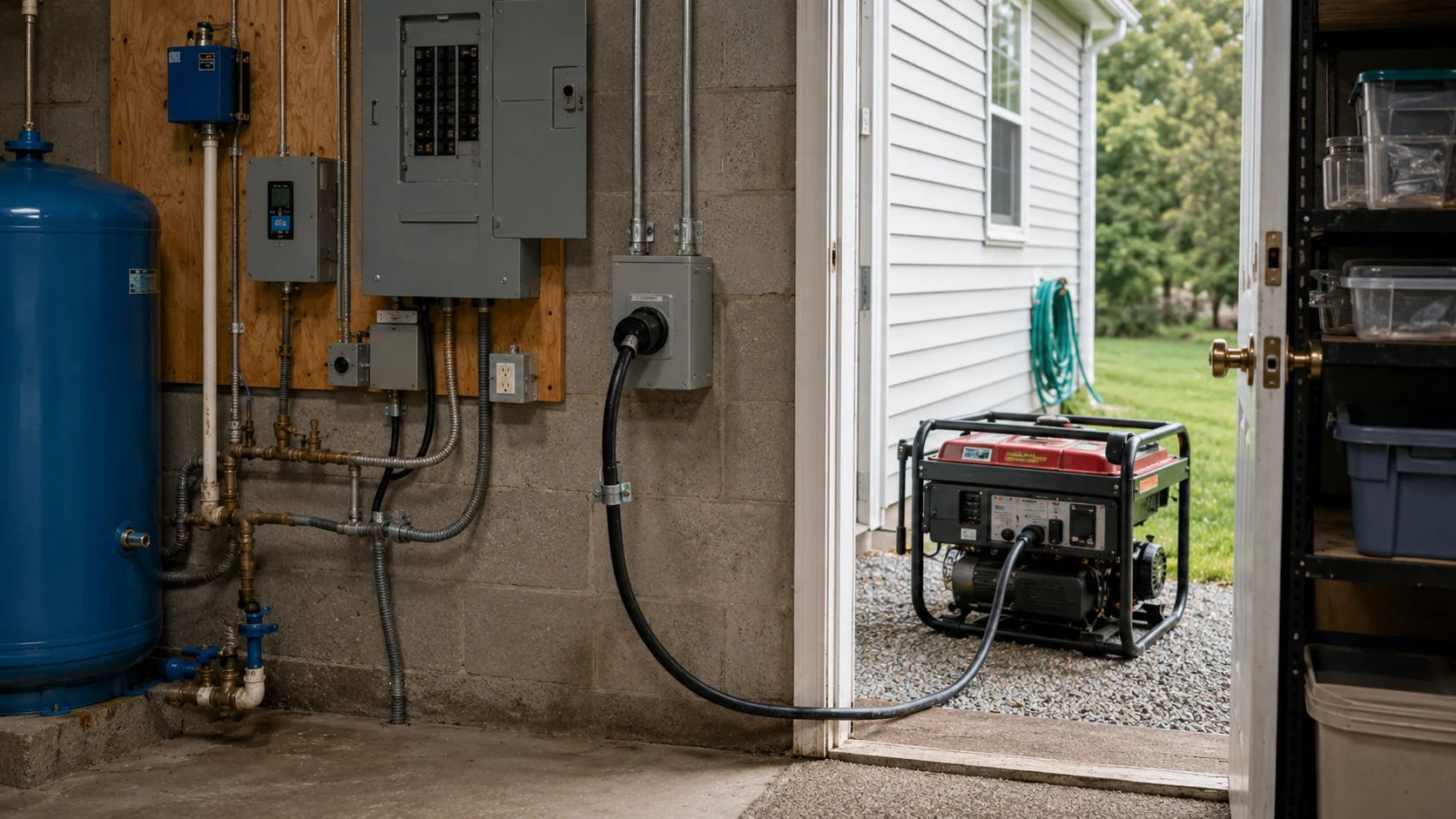
There are three legitimate methods and one that is never acceptable. This page covers what each costs, what each can and cannot power, and where the hard boundary sits.
The thing that is never acceptable
Backfeeding, meaning powering a house by plugging a generator into a wall outlet using a cord with male plugs on both ends.
It is dangerous for two reasons. Without a main breaker disconnect, generator power travels back through your panel to the utility transformer, where it is stepped up to distribution voltage and energises the lines outside your home. Line workers restoring service expect those conductors to be dead. Every year people are killed this way.
Second, it bypasses the protection in your panel. The cord itself is unprotected on both ends, and the exposed pins on a live double-ended cord will electrocute whoever touches them.
The Consumer Product Safety Commission has warned about this repeatedly. It is prohibited under the National Electrical Code, it violates most local ordinances, and it will void your homeowner's insurance in the event of a fire.
There is no version of this that is acceptable, including for a short period, including when you are certain the main breaker is off. Every method below costs a few hundred dollars at most and none of them carry this risk.
Method one: extension cords to individual appliances
The simplest approach. Run properly rated cords from the generator to specific things.
What it powers. Anything with a plug. A refrigerator, a chest freezer, lamps, a phone charger, a fan, a space heater on a suitably rated cord.
What it cannot power. Anything hardwired. That means your furnace, your well pump, your sump pump on a dedicated circuit, your water heater, and your central air. Those loads represent the majority of what actually matters during an outage, which is the fundamental limitation of this method.
Cost. Twenty to eighty dollars per cord depending on gauge and length.
The gauge question. Voltage drop over distance is real and it damages motors. For a run of fifty feet at 15 amps, 12 gauge is the minimum and 10 gauge is better. For a hundred feet, go to 10 gauge. Undersized cords run warm, deliver less voltage than the appliance expects, and shorten the life of anything with a compressor in it.
Where it makes sense. Households whose critical loads all have plugs, in regions where outages run to hours rather than days, and as a temporary measure while arranging something permanent.
For most people this is a starting point rather than a destination, because the furnace blower problem is hardwired and it is the load that turns a winter outage into an emergency.
Method two: interlock kit
An interlock is a mechanical plate fitted to your main panel that physically prevents the main breaker and a dedicated generator breaker from being on at the same time. You cannot backfeed because the geometry will not allow it.
The setup is a generator breaker in your panel, the interlock plate, and an inlet box on an exterior wall connected by a cord to the generator.
What it powers. Any circuit in your panel, including hardwired 240V loads, up to the generator's capacity. This is its major advantage over a manual transfer switch.
Cost. The kit itself runs fifty to a hundred and fifty dollars. The inlet box and cord add a hundred and fifty to three hundred. Electrician installation typically brings the total to somewhere between three hundred and seven hundred dollars.
The catch. Because every circuit is available, nothing prevents you from switching on more than the generator can supply. You manage load manually, by turning off breakers you do not need before starting and adding them back one at a time. That is a discipline rather than a difficulty, but it requires you to know your loads.
The compatibility issue. Interlock kits are panel-specific. The kit must be listed for your exact panel manufacturer and model. A generic or fabricated plate is not listed equipment, will fail inspection, and creates the same liability as backfeeding.
Where it makes sense. Most households, most of the time. It is the best value in this category by a clear margin, particularly for anyone with hardwired 240V loads like a well pump.
Method three: manual transfer switch
A transfer switch is a separate sub-panel wired to a predetermined set of circuits. During an outage you move each circuit's switch from utility to generator.
What it powers. Only the circuits it was wired to, typically six to twelve. You choose them at installation: furnace, refrigerator, well pump, a lighting circuit, a few outlets.
Cost. Three hundred to six hundred for the switch, plus inlet box and cord, plus installation. Total typically five hundred to twelve hundred dollars.
The advantages. Load management is built in, because you physically cannot connect more than the circuits it serves. Many models include wattage meters showing your draw in real time. Operation is simple enough that anyone in the household can do it correctly without understanding the panel.
The disadvantages. Cost, and inflexibility. If you later want to power something that was not wired in, that is another electrician visit. Some smaller units also cannot handle 240V loads, which matters for well pumps and is worth confirming before purchase.
Where it makes sense. Households where several people might need to operate it, or where the owner would rather not manage breakers under stress. Also the better choice where the panel has no room for a generator breaker or no listed interlock exists.
Method four: automatic transfer switch with a standby generator
The permanent version. A fixed generator on natural gas or propane, an automatic transfer switch that detects utility failure, starts the engine, and transfers load without anyone present.
Cost. Several thousand dollars for the generator and several thousand more for installation, gas connection, pad and permitting. Total commonly ranges from six to fifteen thousand dollars.
What it buys. Operation while you are away, transfer within seconds rather than minutes, and no fuel handling. That last point is substantial, because fuel logistics is the practical constraint on portable generators during long outages.
Where it makes sense. Regions with frequent multi-day outages, households with medical equipment, properties with sump pumps where a flood happens whether or not anyone is home, and anyone who travels regularly.
Before committing, check your own region's outage data. If your state averages a few hours a year, as the state-by-state figures will tell you, a standby system is a large amount of money against a small amount of risk.
Comparison
| Extension cords | Interlock | Manual transfer switch | Automatic standby | |
|---|---|---|---|---|
| Typical total cost | $50 to $200 | $300 to $700 | $500 to $1,200 | $6,000 to $15,000 |
| Powers hardwired loads | No | Yes | Selected circuits | Yes |
| Handles 240V | No | Yes | Model dependent | Yes |
| Load management | Manual | Manual, needs knowledge | Built in | Automatic |
| Works while away | No | No | No | Yes |
| Electrician required | No | Yes | Yes | Yes |
| Permit typically required | No | Yes | Yes | Yes |
The inlet box, which both middle options need
An inlet box is a weatherproof, flanged inlet on an exterior wall that accepts a generator cord and connects to your panel. It is what makes an interlock or transfer switch usable, and it is easy to overlook when budgeting.
Size it to the generator. A 30 amp inlet suits generators up to roughly 7,500 watts. Larger units want a 50 amp inlet. The cord must match, and generator cords are specific assemblies rather than heavy extension cords.
Position it where you will actually place the generator, which means at least twenty feet from any door, window or vent, because carbon monoxide from portable generators kills people every year and the mechanism is always that the machine was too close to the house.
Permits, inspection and insurance
Interlocks, transfer switches and standby installations all require permits in most jurisdictions, and the inspection is not adversarial. It confirms the interlock is listed for your panel, the wiring is correct, and the inlet is properly bonded.
It also matters for insurance. An unpermitted generator connection involved in a fire is a straightforward claim denial, and the permit cost is trivial against that exposure.
The National Electrical Code covers this under Article 702, optional standby systems. Your local jurisdiction may amend it, and your electrician will know how.
What I would do
If your critical loads all have plugs and your outages run to hours, buy two good 10 gauge cords and stop there.
If anything that matters is hardwired, which for most households means the furnace, and for well households means the pump, install an interlock kit with an inlet box. It is the best value in this category, it powers everything your generator can carry, and it costs a fraction of the alternatives.
If several people in the household need to operate it, or your panel cannot take an interlock, fit a manual transfer switch instead and accept the higher cost for the simpler operation.
Consider a standby system only if your region genuinely produces multi-day outages, or if a sump pump has to run whether or not anyone is home.
And whatever you choose, never the double-ended cord. Every legitimate option on this page costs less than the consequences of that one.
Sources
- National Electrical Code Article 702, optional standby systems
- U.S. Consumer Product Safety Commission, portable generator safety guidance
- Manufacturer listing requirements for panel-specific interlock kits
Related: What size generator do you actually need covers sizing. How much fuel does a generator use covers running it. Running a well pump during a power outage covers the hardwired 240V load that usually decides which method you need.
This page is general information. Generator connection is regulated electrical work in nearly every jurisdiction and is worth doing with a licensed electrician.
Last verified: July 2026