How Much Fuel Does a Generator Use During a Three-Day Power Outage?
Figures last verified
Nobody actually wants a gallons-per-hour figure. What people want to know is how many cans to fill, or how many propane cylinders to keep, so that a seventy two hour outage does not end with a walk to a filling station that has no power either.
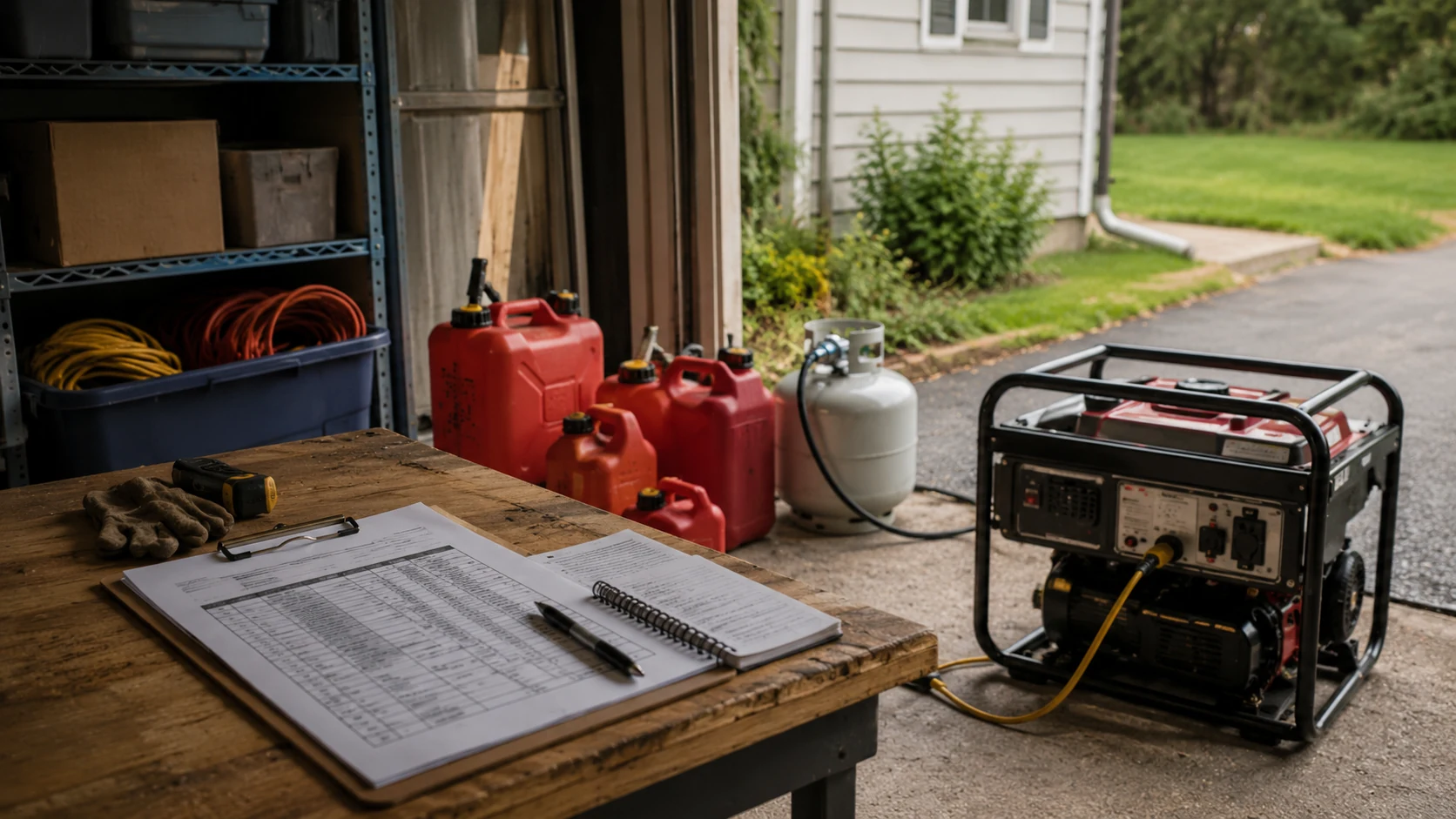
The answer depends on three things: your generator's consumption at the load you will actually put on it, how many hours a day you run it, and which fuel you use. Run it continuously and a three day outage costs somewhere between twelve and forty gallons of gasoline. Run it in scheduled blocks and the same outage costs six to twelve.
That difference is the most useful thing on this page, and it costs nothing.
Why the published figures disagree with each other
Search this question and you will find quoted consumption rates ranging from about 0.2 to 1.5 gallons per hour, with no obvious explanation for the spread.
The spread is real and it has three causes.
Generator size. A 3,000 watt inverter and a 12,000 watt standby unit are different machines. Any figure quoted without a size attached is meaningless.
Load. Fuel consumption scales with load, not with the generator's rating. The same machine at 25 percent load and at 75 percent load consumes very differently, and manufacturers publish run times at specific load points for exactly this reason.
Machine type. A conventional generator runs its engine at a fixed 3,600 rpm regardless of load, because that is what produces 60 Hz. An inverter generator throttles down when the load is light and converts electronically. At light loads an inverter unit can use half the fuel or less, which is why the ranges overlap so confusingly.
The practical consequence: ignore generic figures and use the run time specification for the machine you own or are considering. Every manufacturer publishes it, usually as hours of run time from a full tank at 25 or 50 percent load. Divide tank capacity by run time and you have gallons per hour at that load.
Representative consumption
These are working figures for planning, and your own machine's specification supersedes them.
| Generator | At 25% load | At 50% load | At 75% load |
|---|---|---|---|
| 2,200W inverter | 0.10 gal/hr | 0.16 gal/hr | 0.24 gal/hr |
| 3,500W inverter | 0.15 gal/hr | 0.25 gal/hr | 0.38 gal/hr |
| 5,000W conventional | 0.35 gal/hr | 0.55 gal/hr | 0.80 gal/hr |
| 7,500W conventional | 0.50 gal/hr | 0.85 gal/hr | 1.25 gal/hr |
| 12,000W standby | 0.90 gal/hr | 1.55 gal/hr | 2.20 gal/hr |
Notice that a 3,500 watt inverter at half load uses less than half what a 5,000 watt conventional unit uses at the same fraction of its rating. That is the throttling difference, and over three days it is the difference between one fuel can and three.
Notice also that most households running a furnace blower, a refrigerator and some lighting are sitting at 25 to 40 percent load on a 5,000 watt machine. Buying a larger generator than you need costs fuel every hour it runs, which is the argument the generator sizing guide makes in more detail.
Three operating plans, and what each costs
Take a 5,000 watt conventional generator at roughly 40 percent load, consuming about 0.45 gallons per hour. Apply three different operating patterns to a seventy two hour outage.
Continuous. The engine runs the whole time. 72 hours at 0.45 gal/hr is 32.4 gallons. That is six and a half five-gallon cans, which is more fuel than most households store and more than most will find during a regional outage.
Cycled. Six hours a day, in two three-hour blocks morning and evening. 18 hours at 0.45 gal/hr is 8.1 gallons. Under two cans.
Load-managed. Run only when something needs it: refrigeration reset, water pumping, a heating cycle, device charging. Realistically four hours a day. 12 hours at 0.45 gal/hr is 5.4 gallons. Slightly over one can.
The cycled and load-managed patterns work because of thermal inertia. A closed refrigerator holds safe temperature for about four hours and a full freezer for roughly forty eight, so refrigeration does not need continuous power. A house holds heat for hours depending on insulation. A pressure tank holds water so a well pump does not need to run constantly.
Running in blocks also loads the engine better. A generator idling at ten percent load all night is burning fuel to produce almost nothing, and running fewer hours at higher load is more efficient per kilowatt hour delivered.
Planning for 24, 72 and 168 hours
| Duration | Continuous | Cycled, 6 hr/day | Load-managed, 4 hr/day |
|---|---|---|---|
| 24 hours | 10.8 gal | 2.7 gal | 1.8 gal |
| 72 hours | 32.4 gal | 8.1 gal | 5.4 gal |
| 168 hours (one week) | 75.6 gal | 18.9 gal | 12.6 gal |
Figures for a 5,000 watt conventional unit at 40 percent load. Scale proportionally for your own machine's rate.
How long you should plan for depends on where you live, and that is a question with a real answer rather than a guess. State-level outage data varies by more than twenty five to one, and the outage duration figures by state will tell you whether your realistic planning case is an evening or several days.
Gasoline, propane, or both
Gasoline delivers the most power per unit and is available everywhere until it isn't. Its problem is storage. Ethanol-blended fuel degrades within months, absorbs moisture, and gums carburettors. Stabiliser extends usable life to roughly a year rather than indefinitely, and storing thirty gallons means storing a substantial quantity of a flammable liquid in approved containers, away from the house, rotated on a schedule.
Propane stores essentially forever, which is its decisive advantage. It burns cleaner, it does not gum a carburettor, and a generator that has sat for two years on propane will usually start. It delivers roughly ten percent less power than gasoline for the same engine, and regulators can struggle in severe cold, which matters in exactly the winter events where you need it most.
For planning, a standard 20 lb propane cylinder holds about 4.6 gallons of liquid propane and roughly 430,000 BTU. A 5,000 watt generator at moderate load consumes somewhere around 1.5 to 2 lbs per hour, so a 20 lb cylinder runs it for roughly ten to thirteen hours. A seventy two hour outage on the cycled plan needs about two cylinders. On the continuous plan, closer to six.
Larger tanks change this completely. A 100 lb cylinder is five times a 20 lb, and a 250 or 500 gallon residential tank removes the refuelling problem entirely for weeks.
Dual fuel units run on either, and the modest price premium buys real flexibility. Store propane as the strategic reserve because it keeps, and use gasoline when it is available and fresh.
Natural gas removes fuel storage altogether, which is either the best option available or a false comfort depending on whether your gas supply survives the event. Texas in 2021 demonstrated that gas delivery and electrical supply can fail together for related reasons, and that breakdown is worth reading before assuming the utility will be there.
Storing it without creating a different problem
Approved containers only, meaning containers certified for the fuel and clearly labelled. Store outside the living space, in a detached shed or a garage away from ignition sources and water heaters.
Check your local fire code for quantity limits, because many jurisdictions cap how much fuel may be stored at a residence, and the limits are lower than people assume.
Treat gasoline with stabiliser at the recommended ratio and rotate it into your vehicle every six to twelve months. A rotation habit turns stored fuel from a depreciating hazard into a supply that is always fresh.
Never store fuel indoors, never in a basement, and never in improvised containers. The 2021 Colonial Pipeline event produced widely reported instances of people filling plastic bags, which is exactly the kind of behaviour that a fuel disruption produces and that a small stored supply prevents.
The two habits worth more than the fuel
Run it in blocks. Two to three hours, twice a day. Refrigeration stays cold, the house stays warm enough, water gets pumped, devices charge, and your fuel lasts three to four times as long. It also lets the engine cool, reduces noise complaints, and means the neighbours can sleep.
Exercise it quarterly. The most common generator failure is that it has not been started since it was bought. Carburettors gum with ethanol fuel sitting in them, batteries on electric-start units go flat, and oil degrades. Twenty minutes under load every three months, with stabilised fuel, prevents nearly all of it.
The arithmetic to do before the next storm
Find your generator's run time specification at 25 or 50 percent load. Divide tank capacity by run time to get gallons per hour.
Decide your operating plan. Continuous is expensive and rarely necessary. Six hours a day covers almost everything a household actually needs.
Multiply gallons per hour by daily hours by the number of days your state's outage data suggests you should plan for.
Then store that quantity, in approved containers, with stabiliser, and rotate it. For most households in most states the answer lands somewhere between one and three five-gallon cans, which is considerably less alarming than the continuous-running figure implies.
Sources
- Manufacturer published run time specifications at rated load points
- Propane Education and Research Council, cylinder capacity and BTU content
- FoodSafety.gov, Food Safety During Power Outage, for refrigeration thermal inertia
- Local fire codes govern residential fuel storage quantities
Related: What size generator do you actually need covers matching capacity to loads. How to connect a portable generator covers getting the power into the house safely.
Last verified: July 2026