Can a Portable Power Station Run a Refrigerator and Freezer During an Outage?
Figures last verified
Yes, and the calculation is simpler than most manufacturer pages make it look. A modern refrigerator uses somewhere between one and two kilowatt hours a day. A one thousand watt hour power station therefore runs one for roughly half a day to a full day, and a two thousand watt hour unit covers a refrigerator and a chest freezer for about the same.
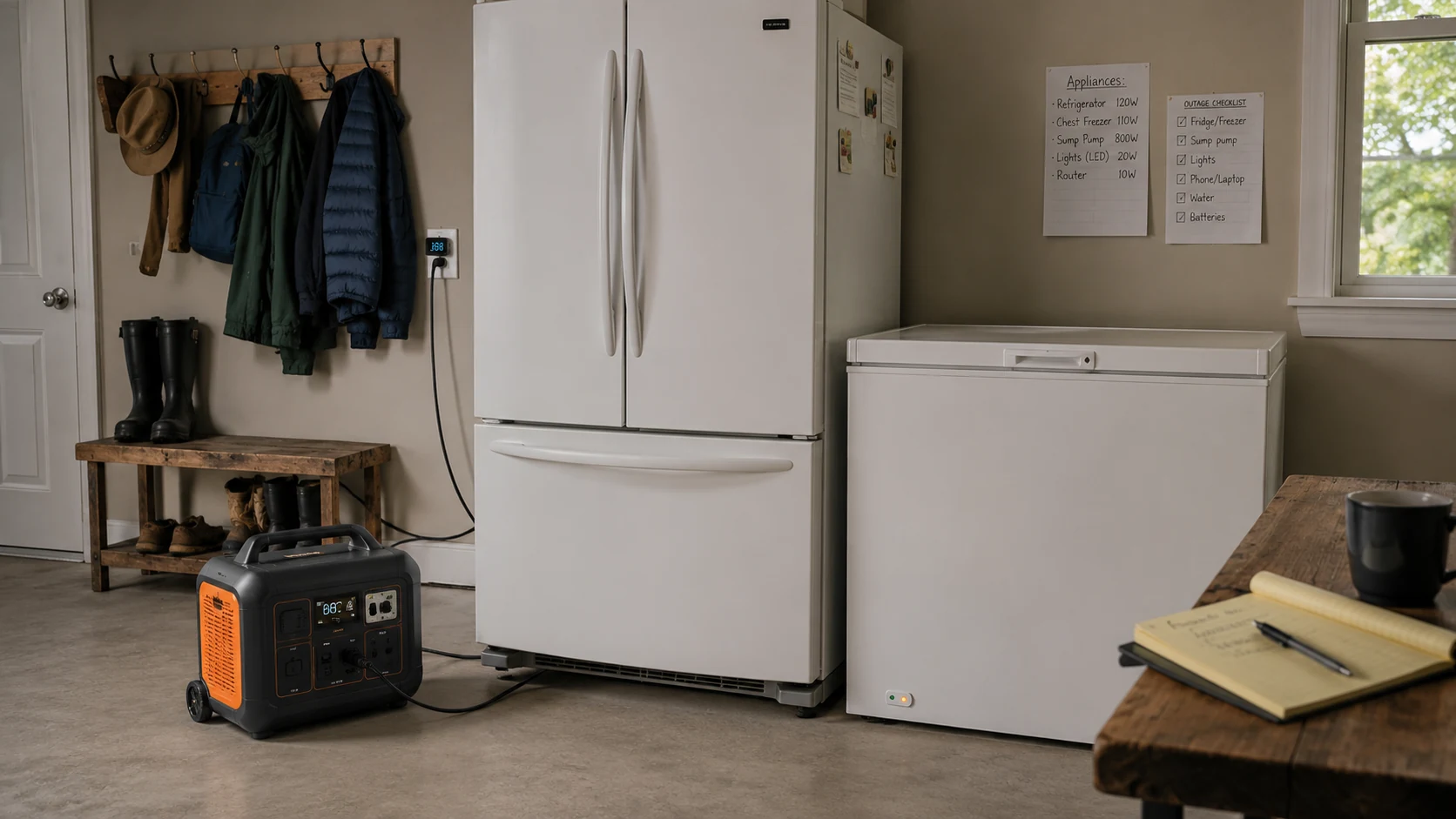
The complication is that four separate numbers govern the answer, and manufacturer articles typically address one of them.
The four numbers
Starting surge. A compressor draws several times its running current for a second or two at startup. A refrigerator running at 150 watts may demand 600 to 1,200 watts at that instant. If the inverter's surge rating falls short, the unit will not start at all regardless of how much energy is stored.
Continuous inverter output. The sustained wattage the station can deliver. This needs to exceed the combined running draw of everything plugged in, with margin.
Daily energy consumption. How many watt hours the appliances actually use over twenty four hours. This is the number that determines runtime, and it is far lower than people expect because refrigerators cycle.
Usable battery capacity. The rated figure is not what you get. Inverter conversion losses run roughly ten to twenty percent, so a nominal 1,000 watt hour unit delivers something closer to 850 watt hours of household AC.
Get all four right and the answer falls out. Get only the third right and you will buy a battery that cannot start the appliance.
Stop guessing the consumption figure
Almost every article on this subject quotes a generic figure like "a refrigerator uses 150 watts." That is a running draw, not a consumption rate, and a refrigerator does not run continuously. Duty cycle is typically thirty to fifty percent depending on ambient temperature, how full it is and how often the door opens.
You do not have to estimate any of this, because the appliance tells you.
Every refrigerator and freezer sold in the United States carries a yellow EnergyGuide label stating estimated annual electricity use in kilowatt hours. If the label is long gone, the Department of Energy maintains an online search tool covering refrigerator and freezer energy ratings by manufacturer, model and year, and most manufacturers publish the figure in the product manual.
The conversion is one division.
500 kWh per year ÷ 365 = 1.37 kWh per day
That is your starting figure, and it is measured under standardised test conditions rather than guessed.
Then adjust upward for reality. During an outage the room is often warmer than the test standard, particularly in summer, and the appliance works harder. Door openings add load. Add twenty to thirty percent as a working margin and you will not be unpleasantly surprised.
| Appliance | Typical annual kWh | Daily kWh | With 25% margin |
|---|---|---|---|
| Modern efficient refrigerator | 350 to 450 | 0.96 to 1.23 | 1.2 to 1.5 |
| Standard refrigerator, 10 years old | 500 to 700 | 1.37 to 1.92 | 1.7 to 2.4 |
| Garage refrigerator, older | 700 to 1,200 | 1.92 to 3.29 | 2.4 to 4.1 |
| Chest freezer, modern 7 cu ft | 200 to 300 | 0.55 to 0.82 | 0.7 to 1.0 |
| Upright freezer, frost-free | 400 to 600 | 1.10 to 1.64 | 1.4 to 2.1 |
Notice the spread. A garage refrigerator from 2008 can use three times what a current kitchen model does, and households frequently want to power both.
Working out runtime
Take the usable capacity of the station, meaning the rated watt hours multiplied by roughly 0.85, and divide by the adjusted daily consumption.
A 1,000 watt hour station has about 850 usable watt hours. Against a modern refrigerator at 1.2 kWh per day adjusted, that is roughly seventeen hours. Against an older unit at 2.0 kWh per day, about ten hours.
A 2,000 watt hour station has about 1,700 usable. That covers a modern refrigerator and a chest freezer together, at a combined 1.9 to 2.5 kWh per day adjusted, for something between sixteen and twenty one hours.
A 3,000 watt hour station covers the same pair for a day and a half or so.
Those figures assume the station is doing nothing else. Add phone charging, a router, a couple of lamps and a fan and you are adding perhaps 300 to 600 watt hours over a day, which is not trivial against a 1,000 watt hour unit.
Why you probably need less than that
Refrigeration is the load where intermittent operation works best, and this is the single most useful operational fact on this page.
A closed refrigerator holds safe temperature for about four hours without power. A full freezer holds for roughly forty eight hours, and a half full one for about twenty four. Those figures come from FoodSafety.gov and they are the basis of the standard food safety guidance during outages.
That thermal inertia means you do not need to power a refrigerator continuously. You need to power it enough to reset the temperature before it drifts too far.
In practice, running the appliances for two to three hours twice a day keeps everything comfortably cold, and it uses roughly forty to sixty percent of the energy that continuous operation would. A 1,000 watt hour station operated that way stretches from seventeen hours of continuous coverage to something closer to a day and a half of practical coverage.
Keep the doors shut between sessions. Every opening costs cold air that has to be replaced with compressor time.
A cheap appliance thermometer inside each unit turns this from guesswork into measurement. Refrigerator below 40 degrees Fahrenheit, freezer at or below zero. When it drifts, run the station. When it is cold, stop.
Recharging matters more than capacity
For an outage lasting more than a day, the recharging path determines everything, and it is the question most people skip.
Solar. A 200 watt panel in good conditions produces roughly 800 to 1,200 watt hours across a day, which covers a modern refrigerator's consumption. Two panels comfortably cover a refrigerator and a freezer. This is the only recharging method that works with no fuel and no grid, and it is the reason a modest station plus panels frequently outperforms a much larger station alone.
Vehicle. Most stations charge from a 12V outlet at a slow rate, typically 100 to 150 watts, which is six to ten hours for a 1,000 watt hour unit. Slow, but it works and you already own the car.
Generator. A small inverter generator running for an hour or two can refill a station quickly, and the combination is genuinely efficient. The engine runs at good load for a short period rather than idling inefficiently all day, and the battery handles the intermittent draw silently overnight.
That last combination is worth considering seriously. A modest generator plus a modest battery often beats either one alone for multi-day outages, and it is quieter at night, which matters more than people anticipate.
Sizing it against your actual situation
If your area averages a few hours of outage a year, which you can check against the state outage data, a 500 to 1,000 watt hour station covers essentially everything you will experience and costs a fraction of the larger units.
If your area runs to multi-day events, capacity alone will not solve it. Any battery you can reasonably afford runs out in a day or two, so the recharging path is the actual purchase decision. That means solar panels, a generator, or both.
And if you are on a well, the refrigerator is not your hardest problem. A well pump's starting surge is several times a refrigerator's, and it may require 240V that most stations cannot supply. That arithmetic is worked through in running a well pump during a power outage.
What to check before buying
Find the EnergyGuide figure or the model's rated annual consumption for every appliance you intend to run, divide by 365, and add twenty five percent.
Check the station's surge rating against the compressor's startup demand, not just its continuous rating against the running draw. A plug-in power meter costing under thirty dollars will show you both directly if the specifications are unclear.
Decide the recharging path before deciding the capacity, because for anything beyond a day the recharging path is what determines runtime.
And put a thermometer in each appliance, because the cheapest way to extend a battery is to run the compressor only when the temperature says it needs it.
Sources
- FoodSafety.gov, Food Safety During Power Outage
- U.S. Department of Energy, refrigerator and freezer energy rating search tool
- FTC EnergyGuide labelling requirements
Related: What size generator do you actually need covers the same arithmetic for engine-driven backup. How to heat a house when the power is out covers the load that usually matters more than refrigeration in winter.
Last verified: July 2026