Gas Generator, Portable Power Station, or Home Battery: Which Backup Actually Fits Your House?
Figures last verified
For most homeowners, a portable generator is the least expensive way to cover long outages, a portable power station is the simplest way to run a few quiet indoor loads, and a professionally installed home battery is the most convenient automatic option. The right choice depends on starting watts, daily energy use, outage length, fuel access, and installation.
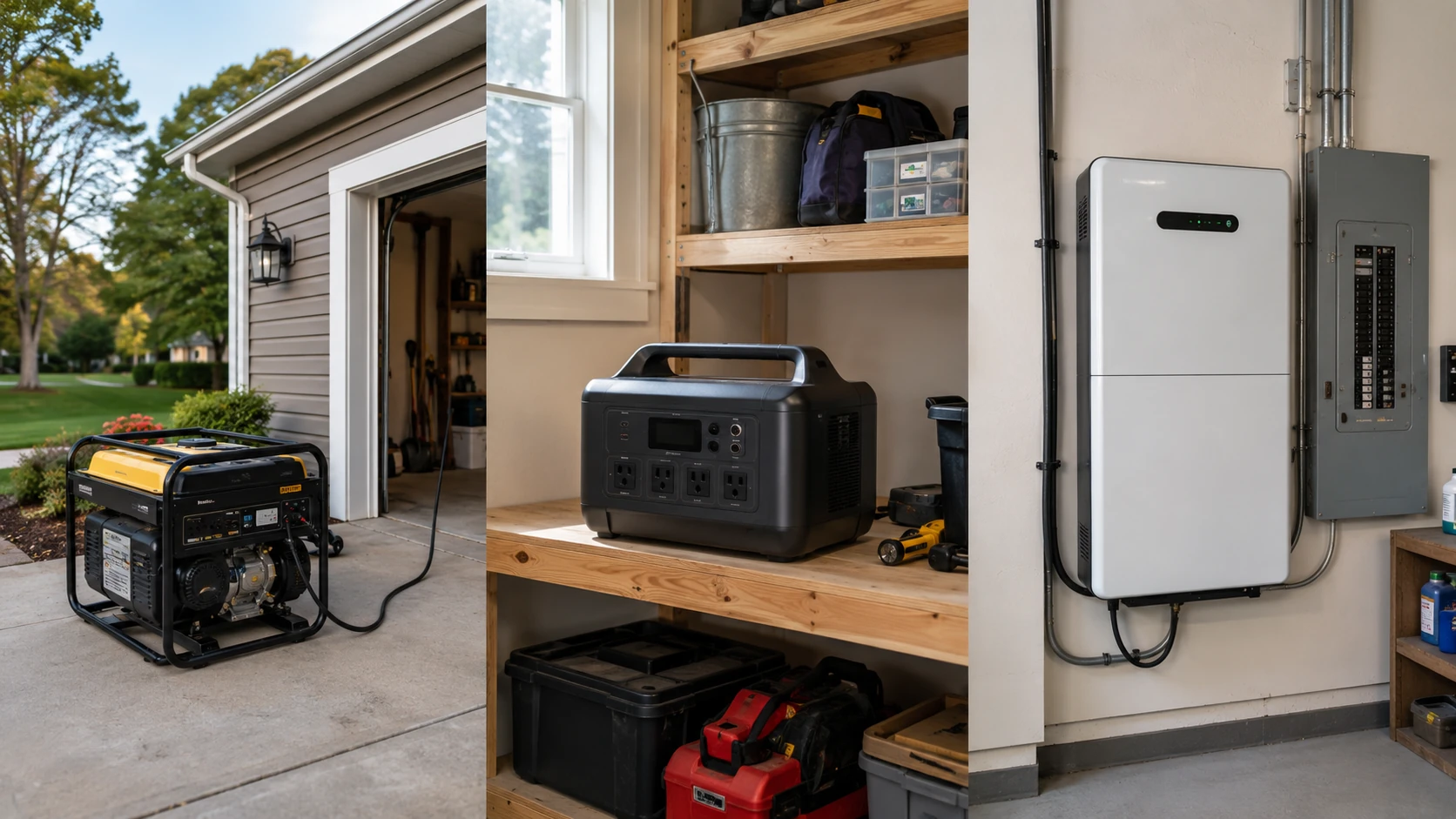
A backup-power purchase often begins with a single appliance. The refrigerator has been off for three hours. The basement is wet enough that the sump pump matters. The furnace is gas-fired, but its blower still needs electricity. A rural house may lose water as soon as the well pump stops.
The shopping pages make the choice look simpler than it is. Generator listings emphasize watts. Battery listings emphasize watt-hours. Home-storage proposals may talk about whole-home backup without stating which loads the installer intends to place on the protected panel. Those figures answer different questions.
The table below is the useful starting point.
| Question | Portable gas or dual-fuel generator | Portable power station | Installed home battery |
|---|---|---|---|
| What is it best at? | Supplying substantial power through a long outage while fuel remains available | Quietly running selected plug-in loads through a short outage | Automatically supporting selected circuits or a carefully designed whole-home system |
| What limits it? | Fuel, maintenance, safe outdoor placement, and generator output | Stored battery energy and inverter output | Stored battery energy, protected-circuit design, and available recharge |
| Can it run indoors? | No. Engine exhaust creates a lethal carbon-monoxide hazard | It produces no engine exhaust while discharging, although the battery and charger still require proper use | Only where the listed system and local code permit installation |
| How well does it handle motor loads? | Often well when running and starting watts are sized correctly | Varies considerably by inverter and surge rating | Varies by inverter, battery configuration, and system design |
| How does it connect? | Heavy-duty cords for individual loads, or approved transfer equipment for house circuits | Directly to appliances, or through compatible transfer equipment on some systems | Permanently installed through dedicated backup equipment and protected circuits |
| What ownership work remains? | Fuel rotation, oil, test runs, engine service, weather planning | Periodic charging, storage checks, cable management, recall checks | Professional installation, system monitoring, inspections, and eventual battery service |
| Who is the natural buyer? | A homeowner facing multi-day outages, large motor loads, a well pump, or limited battery budget | A homeowner protecting refrigeration, communications, medical devices, lights, or electronics | A homeowner who values automatic operation, frequent outage coverage, solar integration, or quiet operation |
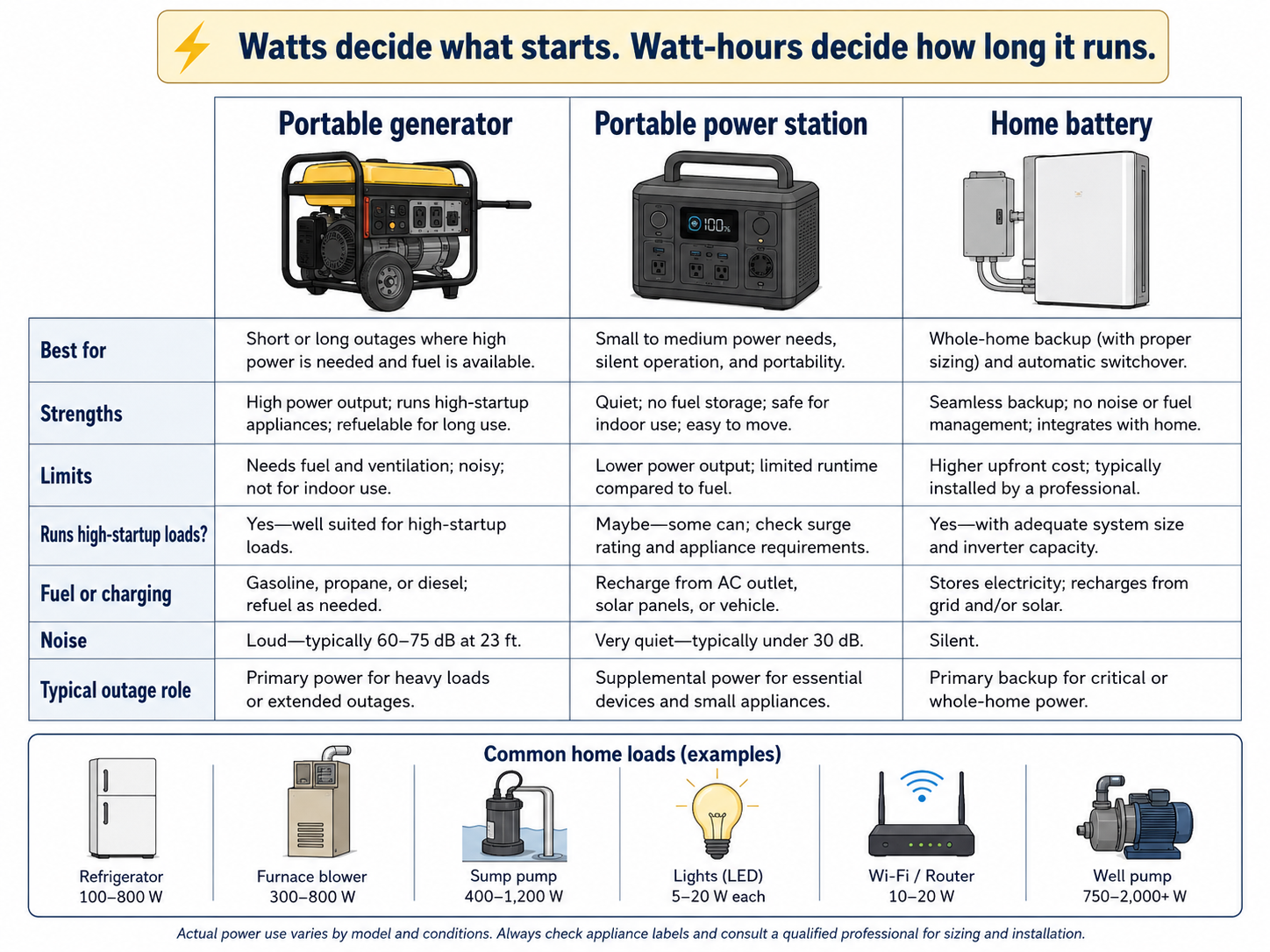
Backup systems should be sized from the ratings and measured consumption of the equipment in the actual house.
What is the difference between watts and watt-hours?
Watts determine whether equipment can run or start. Watt-hours determine how long a battery can keep it running.
That distinction prevents a surprising number of expensive mistakes. A 2,000-watt power station may be able to start a refrigerator and sump pump, but a 2-kilowatt-hour battery does not contain enough energy to run a collection of household loads for several days. A 7,500-watt generator can supply far more instantaneous power, yet its outage duration depends on fuel rather than a watt-hour label.
The basic energy calculation is straightforward:
daily energy in kWh = appliance watts × hours used per day ÷ 1,000
Motors complicate the power side. Refrigerators, freezers, pumps, furnace blowers, and some air conditioners can draw considerably more current during startup than they use once running. The correct figure comes from the equipment manual, nameplate, manufacturer documentation, or an appropriate meter. A vague online wattage chart is useful for a first estimate, but it should not be the final basis for a purchase.
Our generator sizing guide walks through running loads, motor startup, and simultaneous use in more detail. The solar sizing calculator can also be used as a battery-energy worksheet even when no solar panels are planned.
What does a realistic essential-load budget look like?
Consider a house trying to preserve food, heat, drainage, communications, and a few lights. The figures below are an illustrative planning case, not universal appliance ratings. A plug-in energy meter and the labels on your own equipment will produce a better answer.
| Essential load | Planning assumption | Daily energy |
|---|---|---|
| Refrigerator | Measured consumption over 24 hours | 1.2 kWh |
| Chest freezer | Measured consumption over 24 hours | 1.0 kWh |
| Gas-furnace blower | 400 watts for 6 total hours | 2.4 kWh |
| Sump pump | 800 watts for 30 total minutes | 0.4 kWh |
| Router, LED lights, phones, and small electronics | Combined daily allowance | 0.8 kWh |
| Total | 5.8 kWh per day |
A 2 kWh portable power station, with 15 percent reserved for inverter losses and operating margin, would deliver about 1.7 kWh in this planning example. At an average demand of 5.8 kWh per day, that is roughly seven hours. Turning off the furnace blower or running the freezer intermittently would extend it. Adding a second battery would extend it again, but the arithmetic remains the same.
A 13.5 kWh home battery, using the same conservative allowance, would provide about 11.5 kWh toward the load budget. That is close to two days before additional charging. Solar could extend the duration when the array, inverter, controls, weather, and backup configuration all cooperate. Without meaningful recharge, a larger battery still reaches an empty state.
A generator does not have a comparable fixed energy tank. It converts stored fuel into electricity, so it can continue for days if fuel is available and the machine is maintained. That advantage comes with noise, exhaust, refueling, storage, and weather exposure.
This calculation also shows why load reduction deserves attention before equipment selection. During a winter outage, protecting the refrigerator, furnace blower, and sump pump may matter more than running every normal circuit. During mild weather, the furnace load disappears and the same battery lasts much longer.
When does a portable generator make the most sense?
A portable generator remains the practical answer for many detached homes, particularly where outages last more than a day or involve large electrical loads. The Department of Energy describes portable and backup generators as the least expensive backup options, while noting their noise, smell, and carbon-monoxide hazard. Batteries are quieter and scalable, but stored energy has to be purchased in advance.
A generator is especially compelling when the house has a 240-volt well pump, a sump pump that cycles heavily, several freezers, or a gas furnace with a substantial blower. These loads do not necessarily require an enormous generator, but they do require careful attention to voltage, starting current, and which devices may run at the same time.
Its other advantage is recoverability. A depleted battery has to be recharged. A generator can be refueled, assuming roads, fuel supply, storage rules, and the owner’s reserve all cooperate. For a rural homeowner with propane already on the property, a dual-fuel or propane-capable arrangement may simplify storage. Gasoline is widely available before a storm, but it ages and has to be handled deliberately.
Safety is the part that cannot be improvised. The U.S. Consumer Product Safety Commission says portable generators should operate outdoors only, at least 20 feet from the home, with exhaust directed away from windows, doors, and vents. Opening a garage door does not make an attached garage safe. The National Fire Protection Association likewise advises a 20-foot separation and calls for properly rated transfer equipment installed by a qualified electrician when a generator supplies house wiring.
That distance can be awkward on a narrow property, and severe rain or snow creates another planning problem. The placement, weather protection, cord route, fuel storage, and connection method should be solved before the outage. A generator sitting unopened in a box is inventory. A generator that has been safely placed, tested under load, and maintained is backup power.
When does a portable power station make the most sense?
A portable power station is a rechargeable battery, inverter, charger, controls, and outlets in one movable enclosure. It produces no combustion exhaust while supplying power, so selected loads can be run inside the house according to the manufacturer’s instructions. It can keep a refrigerator cold, power a CPAP machine, charge phones, run a router, operate lights, or bridge a short outage without the noise and setup of an engine.
That convenience is easy to overvalue when the energy calculation is skipped. Battery marketing often places the largest visible number on inverter output. The buyer also needs usable watt-hours, surge capability, supported voltage, recharge time, operating-temperature limits, and the output available from the particular receptacle being used.
A power station fits best when the essential-load list is short and deliberate. It is also useful beside a generator. The battery can run quiet overnight loads while the generator is off, then recharge during a daytime generator run. This reduces engine hours and avoids operating the generator continuously for small loads.
Quality and recall history deserve attention. High-capacity lithium battery products can fail, and the CPSC has issued recalls and stop-use warnings for particular portable power stations because of overheating, fire, or explosion hazards. A recognised safety certification, a traceable manufacturer, correct charger, sensible storage location, and a check of the CPSC recall database are worth more than a suspiciously cheap watt-hour figure.
Hardwired equipment may present a connection problem. A furnace blower, well pump, or conventional sump-pump circuit cannot always be powered by carrying the battery into the room and plugging it in. Some systems support approved transfer equipment; others are intended only for cord-connected loads. That detail should be settled before purchase.
When does an installed home battery make the most sense?
A home battery earns its cost through convenience and integration. Properly designed, it detects a grid failure, isolates the house from the utility, and supplies protected loads without the owner moving equipment or starting an engine. The changeover may be fast enough that many electronics continue without an obvious interruption.
The strongest case appears in homes with frequent short outages, time-of-use electricity rates, existing solar, medical or work needs that make interruption costly, or owners who cannot safely handle a portable generator. A battery can provide value on ordinary days by shifting energy use, depending on the utility rate and system configuration. A generator usually sits idle until it is needed.
The phrase “whole-home backup” needs examination. It may describe a system physically connected to the whole panel, but the battery still has finite inverter power and stored energy. Electric resistance heat, central air conditioning, an electric range, an electric water heater, a clothes dryer, and an EV charger can consume a battery reserve quickly. Load-management hardware may prevent the largest loads from operating together.
Residential energy storage is permanently installed electrical equipment. UL explains that model codes require residential energy-storage systems to be certified to UL 9540 and impose installation conditions that can include capacity, spacing, and location requirements. Local rules vary, so the installer, authority having jurisdiction, utility, and equipment documentation all matter.
A home battery also changes the repair model. A small portable unit can be unplugged and replaced. A wall-mounted system is part of the house. Warranty terms, installer longevity, remote support, replacement availability, and the ability to operate when cloud services are unavailable deserve a place beside capacity and price.
Will rooftop solar keep the battery charged during an outage?
Solar panels alone usually do not keep an ordinary grid-tied house running when the grid fails. The inverter is normally required to stop energizing the circuit so utility workers are not exposed to power flowing back onto lines under repair. The Department of Energy explains that storage or suitable backup equipment is needed to make solar electricity available during an outage.
A solar-plus-storage system can recharge during daylight, but the result depends on weather, array production, battery state, inverter limits, and daytime household demand. A 10 kW array does not produce 10 kW all day, and snow, shade, clouds, roof orientation, and season all change the energy collected.
The useful question is whether the array can produce more energy during a representative bad-weather day than the protected loads consume. If the house uses 5.8 kWh per day for essential loads and the array contributes only 3 kWh during a dark winter day, the battery still loses 2.8 kWh from one day to the next. Solar slows depletion, but does not stop it in that example.
What should you measure before buying backup power?
Begin with the loads whose loss creates a real consequence. Refrigerated food is an obvious example. FoodSafety.gov states that an unopened refrigerator keeps food cold for about four hours, while a full freezer holds temperature for roughly 48 hours, or 24 hours when half full. That creates a useful response window. It does not mean every refrigerator must run continuously from the first minute of an outage.
Write down each essential device, its voltage, running watts, startup requirement, and expected daily runtime. Separate plug-connected appliances from hardwired loads. Then decide which loads may operate simultaneously. A homeowner who is willing to alternate the freezer, sump pump, and furnace can often buy less equipment than someone expecting every circuit to behave normally.
Also examine the house rather than only the appliances. Where can a generator sit 20 feet from openings? How will cords avoid water and trip hazards? Is there a legal fuel-storage location? Which circuits would an electrician place on a critical-load panel? Can the battery installation meet clearance and temperature requirements? Is the owner physically able to move, start, and refuel the proposed machine?
Finally, choose an outage duration. Our review of how long power outages actually last explains why a system sized for the common interruption may be more rational than attempting to reproduce normal life indefinitely. A short battery bridge paired with a longer-duration fallback can be more resilient than one oversized device.
How should backup equipment connect to the house safely?
Individual cord-connected appliances may be plugged directly into a generator using suitable outdoor-rated cords, following the generator and appliance instructions. Supplying house wiring requires approved transfer equipment that prevents the backup source from energizing utility lines. NFPA advises having a qualified electrician install a properly rated transfer switch in accordance with the National Electrical Code and applicable local rules.
The same principle applies to batteries. A portable power station should not be connected to a wall receptacle to energize household wiring. Installed batteries and portable systems designed to feed selected circuits need listed, compatible transfer and isolation equipment.
This article provides general planning information, not electrical design advice. A licensed electrician should determine the connection method, conductor sizing, grounding and bonding requirements, permits, and compatibility with the home’s service equipment.
Which backup source should you choose?
Choose a portable generator when the main problem is long duration, high starting loads, a well pump, electric motors, or limited purchase budget. The plan needs safe outdoor space, a compliant connection method, stored fuel, maintenance, and a person able to operate it.
Choose a portable power station when the main problem is keeping a small set of essential loads alive quietly and with little setup. It is especially useful for refrigeration, communications, lights, medical equipment, electronics, and overnight use. Confirm both the watt-hour capacity and the inverter’s ability to start the intended equipment.
Choose an installed home battery when automatic operation, low noise, frequent outages, solar integration, or accessibility justifies the installation cost. Insist on a written protected-load design and a realistic runtime calculation rather than relying on the phrase “whole-home.”
Many households will arrive at a hybrid. A portable battery handles the first few quiet hours. A generator covers a prolonged interruption and recharges the battery. Solar contributes when conditions permit. The pieces should be selected around measured loads, because the cleanest-looking system can still fail when the sump pump starts.
Short version
A generator usually buys the most outage duration and motor-starting ability for the money, provided it can be operated outdoors, fueled, maintained, and connected safely. A portable power station is easier to live with and useful indoors, but its runtime is governed by stored watt-hours. An installed home battery provides the smoothest experience and can work well with solar, although its duration remains finite.
Measure watts, startup demand, and daily kilowatt-hours before comparing products. Protect the few loads that prevent expensive or dangerous consequences. Then select the equipment around the actual house rather than the largest number printed on the box.
Sources
- U.S. Department of Energy, “The Road to Resilience with Rooftop Solar”
- U.S. Department of Energy, “Solar-Plus-Storage 101”
- U.S. Department of Energy, “Homeowner’s Guide to Solar”
- U.S. Consumer Product Safety Commission, generator carbon-monoxide and fire guidance
- National Fire Protection Association, Generator Safety Tips
- FoodSafety.gov, Food Safety During a Power Outage
- UL Solutions, Marking on Energy Storage Systems for Residential Use
- U.S. Consumer Product Safety Commission, Recalls
Last verified: July 2026